Showing posts with label Education. Show all posts

Monday, May 11, 2026

Slow Violence: Confronting Dark Truths in the American Classroom

Ray, Ranita. Slow Violence: Confronting Dark Truths in the American Classroom. 2025. 336p. ISBN 9781250288301.


When Dr. Ranita Ray began studying a specific school in Las Vegas, she was initially focused on resource shortages and budget cuts. However, she quickly uncovered a far more insidious problem: "slow violence." This concept describes the routine psychological, emotional, and physical harm inflicted upon vulnerable students by the very educators and administrators meant to care for them. Her research reveals how a pervasive culture of indifference, verbal abuse, and harassment acts as a significant impediment to a child's well-being and academic success, laying bare the profound, lasting damage caused behind closed classroom doors.

Slow Violence presents several compelling case studies to illustrate this slow violence. We meet Nazli, a bright student told to use "grit" to overcome her brother's death; Reggie, a curious scholar whose future is derailed after an unfair accusation of being a predator; Nalin, a new Filipina student whose potential is ignored due to an academic stereotype; and Miguel, a sharp Latino boy incorrectly diagnosed with autism by his teachers. These stories go beyond common discussions of funding or achievement gaps, offering a crucial new perspective that argues for a fundamental change in how we approach education reform by first addressing how children experience the classroom.

Tuesday, March 3, 2026

In Support Of Students: A Leader's Guide to Equitable MTSS

Novak, Katie and Kristan Rodriguez. In Support Of Students: A Leader's Guide to Equitable MTSS. 2023. 256p. ISBN 9781119885269.

In Support of A Leader’s Guide to Equitable MTSS offers a practical and evidence-based approach to establishing multi-tiered systems of support (MTSS) in schools. A team of experienced educators provides concrete strategies and tools designed to aid in the effective implementation and redesign of systems that cater to the diverse needs of all students. In Support of A Leader’s Guide to Equitable MTSS moves beyond theoretical concepts, offering grounded, hands-on guidance for developing MTSS frameworks that not only promote high levels of learning but also foster students' sense of belonging and hope.

This comprehensive playbook serves as an essential resource for K-12 school leaders and administrators seeking to create equitable and effective MTSS. Its research-driven insights and practical advice also make it a valuable tool for policymakers, university personnel, and regional support providers involved in shaping educational systems. The book emphasizes the importance of creating environments where all learners can thrive academically and feel a strong connection to their school community.

Tuesday, December 2, 2025

Education Across Borders: Immigration, Race, and Identity in the Classroom

Sylvain, Patrick, Marie Lily Cerat, and Jalene Tamerat. Education Across Borders: Immigration, Race, and Identity in the Classroom. 2022. 144p. ISBN 9780807052808


Education Across Borders explores the systemic disadvantages faced by Black, Indigenous, and People of Color and first-generation students within the U.S. educational system, highlighting the correlation between non-inclusive environments and increased dropout rates, stress, and anxiety. Three educators, drawing from their own experiences as immigrants, advocate for culturally relevant pedagogy as a crucial tool to combat racial inequity and ensure student success. Education Across Borders aims to benefit white educators in particular, offering reflections and strategies for valuing the diverse experiences of their students.

Focusing on Haitian and Dominican students, the authors explore the specific challenges faced by immigrant and first-generation learners. They delve into the intersections of language policies and social justice, the use of culturally relevant teaching and community knowledge to enhance curriculum, student-centered classroom practices, and strategies for supporting Haitian Creole-speaking students. The book serves as a practical guide for creating inclusive classrooms that foster the academic and emotional well-being of all students, particularly those from marginalized backgrounds.

Tuesday, October 21, 2025

Racial Opportunity Cost: The Toll of Academic Success on Black and Latinx Students

Chamber, Terah Venzant. Racial Opportunity Cost: The Toll of Academic Success on Black and Latinx Students. 2022. 232p. ISBN 9781682537442.


Racial Opportunity Cost examines the unique obstacles faced by high-achieving Black and Latinx students, particularly in predominantly white educational settings. Introducing the concept of "racial opportunity cost," the author explains the many tradeoffs and challenges these students encounter on their path to academic success. Through firsthand accounts from students, educators, and researchers, the author highlights the prevalence of educational racism, peer and cultural isolation, and struggles with racial identity, even among those who are academically successful.

Racial Opportunity Cost demonstrates how these secondary stressors negatively impact students' educational experiences from K-12 through postsecondary education and beyond. Factors such as school culture, intersectionality, and community acceptance influence racial opportunity cost. By connecting individual experiences to systemic issues, the author provides a framework for educators to proactively address these challenges. The book aims to equip educators with the tools to cultivate inclusive environments, reduce racial opportunity cost, and improve the overall experiences of high-achieving students of color.

Tuesday, September 9, 2025

Go Big: The Secondary School Survival Guide

Burton, Matthew. Go Big: The Secondary School Survival Guide. 2020. 208p. ISBN 9781526362353.

Go Big: The Secondary School Survival Guide book cover

Go Big offers practical advice and encouragement for students navigating the challenges of secondary school. For many students, the move from middle school to high school comes with its share of anxiety, navigating complex social dynamics, new demands on one's time, and, of course, all of the academics and extra-curricular activities that come from being a student in a large school. 

Aiming to build a strong foundation for future success, Go Big addresses common concerns faced by high school students, such as peer pressure, challenging friendships, and the stress of academic demands. Practical strategies for exam preparation, time management, and building confidence are presented. The author shares his own experiences and offers words of wisdom meant to empower young readers to embrace their individuality, overcome obstacles, and strive for their personal and academic goals. 

Go Big serves as a valuable resource for students seeking to navigate the complexities of high school with greater ease and confidence.

Tuesday, September 2, 2025

STEM for All: How to Connect, Create, and Cultuvate STEM Education for All Learners

Bakshi McLean, Leena. STEM for All: How to Connect, Create, and Cultuvate STEM Education for All Learners. 2024. 288p. ISBN 9781394221448.

STEM for All: How to Connect, Create, and Cultuvate STEM Education for All Learners book cover

STEM education has often been lacking for minority students, for students learning English, and for students with a low socio-economic status. Yet educators claim to want to help every student succeed. STEM for All offers a comprehensive guide for educators seeking to improve STEM education and address the persistent achievement gap. Drawing upon the Connect, Create, and Cultivate framework from STEM4Real, practical tools and strategies for creating inclusive and engaging learning environments are showcased. Critical factors that impact student success in STEM are explored, including classroom culture, discourse, identity, family involvement, and equitable access to resources. Through real-world examples and case studies, the importance of addressing implicit biases and fostering a sense of belonging for all students is highlighted.

By identifying and overcoming the challenges that hinder student engagement in STEM, educators can create more equitable and effective learning experiences. STEM for All equips educators with the knowledge and tools to implement culturally relevant teaching practices, build strong relationships with students and families, and ultimately close the STEM gap, ensuring that all students have the opportunity to succeed in science, technology, engineering, and mathematics. STEM for All is a valuable resource for teachers, instructional coaches, and school leaders committed to improving STEM education and preparing students for future success in a rapidly changing world.


Tuesday, May 6, 2025

College: What It Was, Is, and Should Be

Delbanco, Andrew. College: What It Was, Is, and Should Be. 2023. 280p. ISBN 9780691246376.

College: What It Was, Is, and Should Be book cover

Over the last decades, the traditional four-year college experience, characterized by exploration and intellectual growth, has been eroded by the increasing emphasis on pre-professional training, threatening the very essence of the meaning of liberal arts education. Our understanding of what a liberal arts education is an environment which fosters critical thinking, intellectual curiosity, and a broader understanding of the world. This transition to more technical and professional training originates with the push towards more STEM and STEAM education, and a shift towards emphasizing technical skills.

College: What It Was, Is, and Should Be traces the historical evolution of the American college, highlighting its origins in Puritan thought and its gradual expansion to include women, minorities, and students from diverse socioeconomic backgrounds. It argues for the enduring value of a humanistic education in an increasingly globalized world, acknowledging the importance of STEM fields while advocating for a balanced curriculum that cultivates well-rounded individuals. The challenges that face higher education today, such as financial, intellectual, and ethical issues are important, but ultimately, preserving the ideals of a liberal arts education remains crucial for the continued success of American democracy.

Tuesday, April 8, 2025

The A.I. Roadmap: Human Learning in the Age of Smart Machines

Spencer, John. The A.I. Roadmap: Human Learning in the Age of Smart Machines. 2023. 322p. ISBN 9781734172645.

The A.I. Roadmap: Human Learning in the Age of Smart Machines book cover

Artificial Intelligence (AI) promises to revolutionize how we educate people. The same promises have been made with the Internet, machine learning, and even older technologies such as the audiocassette and the film strip. This time, however, it may be true, but uncertainty and the rapid pace of changes means that the verdict of AI's impact on education remains unclear.

Recognizing that a prescriptive approach is neither feasible nor appropriate, The A.I. Roadmap suggests several paths educators can navigate as they experience this evolving landscape, steering away from the extremes of completely restricting AI (Lock It and Block It) and blindly embracing technological advancements (Techno-Futurism).

Instead, what is needed is a human-centered and tech-infused approach. The A.I. Roadmap explores how AI is transforming various aspects of education, such as creative thinking, information literacy, project-based learning, assessment, and personalized learning. It analyzes how AI is impacting each subject area and provides suggestions of best practices, recognizing that what exists today will be vastly different in a few months. Finally, it offers guidance on how educators can leverage AI tools while maintaining a focus on human values, critical thinking, and the development of essential human skills, elements that will continue to set us apart from the machines taking over multiple aspects of our society.


Tuesday, January 14, 2025

Running the Room: The Teacher's Guide to Behavior

Bennett, Tom. Running the Room: The Teacher's Guide to Behavior. 2020. 346p. ISBN 9781913622145.

Running the Room examines the crucial role positive classroom behavior plays in fostering successful learning environments. Effective behavior management is not about punishment, but rather about teaching and cultivating essential social and emotional skills in students. It highlights the importance of creating a calm and respectful classroom where all students feel valued and supported. Recognizing that every child comes to the classroom with unique experiences and needs, teachers must devise a tailored approach to behavior management.

Running the Room provides teachers with practical, evidence-based strategies and techniques for creating a positive classroom culture. Drawing on the expertise of educators worldwide, it offers valuable insights and guidance on building strong relationships with students, establishing clear expectations, and implementing effective classroom routines. By emphasizing the importance of viewing behavior as a curriculum, the book empowers teachers to create a learning environment where both students and teachers can thrive.

Tuesday, October 15, 2024

Reconnect: Building School Culture for Meaning, Purpose, and Belonging

Lemov, Doug, Hilary Lewis, Darryl Williams and Denarius Frazier. Reconnect: Building School Culture for Meaning, Purpose, and Belonging. 2022. 272p. ISBN 9781119739975. 

Reconnect: Building School Culture for Meaning, Purpose, and Belonging book cover

The smartphone is undermining the mental health and education of our children. It is becoming a plague, causing anxiety, depression, anguish, and thus affecting the learning that children perform in schools. Many schools are now in the process of banning cellphones, from limiting their use to specific times of day to outright bans on campus. In Reconnect, several distinguished educators argue that schools must improve the sense of belonging that students experience when they are present to improve their lives and the learning that occurs.

Drawing on extensive experiences and studies that examined high-performing schools, the authors suggest multiple pathways that can be used to build a learning environment where students feel loved and protected, where they are free to be themselves and socialize with their peers in a risk-free environment. A practical guide for how schools can change how they operate to facilitate the reconnection of their students to the society they live in, Reconnect provides a guide to improving the environment and helping students become more confident and better learners. 

Tuesday, February 14, 2023

Doing Hermeneutic Phenomenological Research: A Practical Guide

Dibley, Lesley, Suzanne Dickerson, Mel Duffy, and Roxanne Vandermause. Doing Hermeneutic Phenomenological Research: A Practical Guide. 2020. 232p. ISBN 9781526485724.


Studying how people experience a phenomenon through a phenomenological approach can be rewarding, but the concepts behind phenomenology emerge from philosophy instead of a quantitative research tradition. Thus, mastering the elements that constitute a phenomenological study can be daunting to the novice researcher. The authors, all professional nurses and nurse educators, set out to clearly explain the history of phenomenology, the philosophical discussions and assumptions that underpin much of its theoretical framework. the methodology that is used hermeneutically, and provide specific advice on how to conduct such a study, from inception to delivery of an article to a scholarly journal, while engaging reflexively with the entire process to ensure that it truly reflects the thematic that arise out of the lived experience of the subjects.

Tuesday, November 29, 2022

Teach Like Finland: 33 Simple Strategies for Joyful Classrooms

Walker, Timothy D. Teach Like Finland: 33 Simple Strategies for Joyful Classrooms. 2017. 240p. ISBN 9781324001256. Available as an audiobook from Overdrive


Back in 2001, students from countries belonging to the Organization for Economic Co-operation and Development participated in a brand new test, called the PISA, which was designed to determine skills in the fields of math, reading and science, and provide an ranking. To everyone's surprise, Finland came out on top, with Finnish students netting top scores in all three categories. How did Finland, with a small population, significantly less educational spending than the average American school, a significantly lower amount of hours spend in classes per year, and with teachers that rarely work longer hours than the students manage to outshine everyone else?

Timothy Walker started his teaching career in the United States, before moving to Finland with his wife and child so they could be closer to her family. There, he joined the Helsinki public school system, and got a job teaching 5th grade students. Walker thought he was well-prepared to take on this assignment, but it turns out that he had to forget many of the habits he had acquired in American schools in order to become a successful teacher.

In this book, Walker outlines 33 strategies he observed in Finnish schools that may explain why Finnish students are on average more proficient than American or even Asian students despite spending less time and money. From assigning less homework, to sticking with more traditional lecture formats but then providing more time for students to explore on their own, from a more relaxed educational environment where the pressure to perform and to pursue further professional learning opportunities are not present, and from a system where teachers are encouraged to leave school very soon after the students, Finland can teach a thing or two on how to offer a more peaceful, focused, and conducive to learning school environment.

Tuesday, November 8, 2022

I Wish My Teacher Knew: How One Question Can Change Everything for Our Kids

Schwartz, Kyle. I Wish My Teacher Knew: How One Question Can Change Everything for Our Kids. 2016. 272p. ISBN 9780738219141. 


A simple question can be a powerful motivator for change. When Kyle Schwartz asked her primary school students at the beginning what she as their teacher should know, she got many messages about loving pets, favorite activities, and best friends. But she also got heart wrenching stories about families being broken, parents being in prison, medical issues that plagued the student or a loved one, and many others. She realized that she had opened a dialogue with students by asking them a question and giving them license to answer in any way they saw fit.

Schwartz's message is that educators must ask important questions to understand the hidden realities that students experience in their lives inside, but more importantly, outside of school, as these realities impact how they learn. This powerful question allows the teacher to lay down the foundations of a safe and supportive environment for all students, allowing everyone to successfully participate as full-fledged members of the classroom and of the school.

Friday, October 21, 2022

The Shallows

Carr, Nicholas. The Shallows: What the Internet is Doing to our Brains. 280p. ISBN 9780393339758.


Anyone who has grown up in the 1980s and early 1990s shake their head at the children of today, who are coming of age in an era where the Internet is ubiquitous. Back in the last decades of the 20th century, it was important to learn phone numbers, memorize dates, state capitals, and learn how to retrieve information in encyclopedias. Now, this information and more is available one keyboard or dictation away. In The Shallows, Carr argues that though this is all wonderful, the Internet is also making us dumber, as we rely on it more and more instead of actually learning information.

The Internet provides access to a wealth of knowledge, but paradoxically it undermines our ability to read deeply, and think about what we read. Neurological studies have demonstrated that our brains are being rewired as we move away from reading books into the more shallow waters of the Internet, leading us away from an ability to concentrate and reflect on what we read and what it all means. Far from being a panacea, the Internet is causing us to become more shallow versions of what we have been. 

Readers who are interested in what the Internet means for human development will appreciate this deep dive into the impacts a worldwide network of computers is having on the human brain, on how we interact with each other, and on how we pursue knowledge.

Wednesday, June 15, 2022

E-Learning and the Science of Instruction: Proven Guidelines for Consumers and Designers of Multimedia Learning

Clark, Ruth and Richard Mayer. E-Learning and the Science of Instruction: Proven Guidelines for Consumers and Designers of Multimedia Learning. 2016. 528p. ISBN 9781119158660. 


The shift to e-learning has led to an explosion of multimedia options. Online courses can now incorporate presentations, videos, audio, and text-based discussions to facilitate learning. Many of these tools, however, are not used properly. Cognitive psychology and principle of learning often contradict each other, and changes in how we understand the way the human brain works continue to add to our knowledge of cognitive science. 

Designed for course instructors and for multimedia creators, E-Learning and the Science of Instruction explores the psychology behind how we learn and presents the most effective techniques to ensure that the communication of information to learners is as effective as possible.

Friday, October 1, 2021

What We Say and How We Say it Matter

 Anderson, Mike. What We Say and How We Say it Matter: Teacher Talk that Improves Student Learning and Behavior. 2019. 168p. ISBN 978-1-4166-2704-3. 

What We Say and How We Say It Matter: Teacher Talk That Improves Student Learning and Behavior

Every teacher strives to make sure that each and every student is successful. But the words that we use, and the way in which they are expressed can often convey the opposite of what we wished to communicate. Language can easily sabotage all efforts made to ensure that students love their learning experiences while at school.

In this provocative book, the author provides a road map to focus on words and ways of speaking that are not conducive to students developing positive attitudes towards school. Words like "I'm disappointed" indicate to students that they better perform for the teacher, instead of wanting to perform for themselves. The ownership of the language ("you didn't turn in my homework") can indicate to students that it's not really their performance and their work, but rather that of the teacher. And extrinsic motivation such as stickers or pizza parties undermine any intrinsic motivation possessed by students.

Teachers and other professionals who work with people will read a lot of concrete advice that can help change what they do to become more positive and instill a joy of learning that used to be there, as anyone who has ever observed preschoolers or kindergarten students can attest. Specific techniques are described, and can help make the transition to a more powerful language habit that will actually support what the teacher is trying to achieve, instead of unwittingly undermining what they do. 

Friday, September 10, 2021

Crescendo

 Cheney, Allen and Julie Cantrell. Crescendo: The Story of aMusical Genius Who Forever Changed a Southern Town. 2019. 336p. ISBN 9780785217404.

Crescendo: The Story of a Musical Genius Who Forever Changed a Southern Town

On the day that Fred Allen died, his sister, who was pregnant, went into labor and delivered a healthy baby boy that she named Fred in honor of her deceased brother. The midwife who helped deliver baby Fred was also known as an oracle, and she predicts that the baby will be very smart, but also very different. Born in striking poverty in rural Georgia during the Great Depression, Fred soon reveals that he is a gifted musician when at three years of age he can play full pieces on the piano without missing a single note. 

His parents work in the cotton mills, and their abject poverty and crushing existence lead to Fred being neglected and sexually abused by an uncle. He finds salvation in music, however, and rediscovers his love for singing and playing. Motivated and encouraged by dedicated educators and mentors, Fred escapes his family and heads to college. There he meets Winnie, the love of his life, and after graduation they marry. Fred continues to play music and to seek out a career in the field. Having made many contacts along the way, he moves to New York City with his wife and young daughter and enrolls at the Juilliard School, Union Theological Seminary, which possesses the best organ anywhere in the world, and Columbia University. Juggling all three schools, playing in a church in New Jersey, and his wife and daughter, Fred earns a position at RCA records, and wins Grammies for his producer talents.

None of these accomplishments are fulfilling, however, and Fred still dreams of Broadway. A crushing depression brought on by the developing awareness of his abuse as a child forces him to re-evaluate his priorities, and he moves his family away from New York back to Thomasville, Georgia, where he becomes the leader of a youth choir, and soon joins the faculty at the local high school. With his wife and daughter, he creates an amazing musical program that forty years later continues to be successful.

Fred's life as a musician and educator forever changed so many lives. His positive outlook and his dedication transformed sulky and taciturn teenagers into some of the best singers of his time. Fred's life is proof positive that the impacts educators have on their students can never truly be measured.

Tuesday, May 4, 2021

The Gamification of Learning and Instruction: Game-Based Methods and Strategies for Traning and Education

Kapp, Karl M. The Gamification of Learning and Instruction: Game-Based Methods and Strategies for Traning and Education. 2012. 302p. ISBN 9781118096345.

The Gamification of Learning and Instruction: Game-Based Methods and Strategies for Training and Education


In the last 30 years, the arrival of computers in schools changed education from a process driven by a teacher standing in front of the classroom distributing information while students took notes, to one where students are increasingly more responsible for guiding their own learning. One of the major change that has occurred has been the addition of games in educational settings, particularly video games. Used as engaging tools to develop skills and deliver content, digital games have evolved from off-the-shelf commercial games adapted for narrow purposes in specific school programs, to a bevy of educational games developed specifically for the educational market and its 1:1 program of providing a device for every student.

Digital engagement is important to motivate students and foster curiosity, but games can do so much more, from developing life-long interests to exploring topics in a safe and secure manner. Ultimately, gamification gives the student more control over their own educational outcomes. The Gamification of Learning and Instruction explores what gamification is, and how games can be developed to achieve specific learning goals and objectives. Learning theories are explored and applied to gamification, and the results of decades of research is presented to explain how games can be effective in education. The various types of game players are examined, before delving into the role of novice and expert players. Finally, gamification design processes are outlined. 

Those interested in how games can be implemented in a classroom will appreciate the details presented in this book that remains factual almost a decade after being first published.

Friday, April 9, 2021

Digital Games and Learning: Research and Theory

Whitton, Nicole. Digital Games and Learning: Research and Theory. 2014. ISBN 978-0-415-62939-3.

Theory and Research in Games and Learning: How It Can Enhance Teaching and Learning

Though educational computer games have existed for decades, the arrival of the iPad and competing tablets suddenly trust the educational market wide open for developer of apps and for those who were interested in creating and sustaining motivation while learning digitally. In this well-researched book, Whitton discusses the theoretical underpinnings of motivation and how these apply in the world of digital learning. She dives into game theory and how it can be used to foster learning and interest. She considers how gamification and play can be implemented in almost every facet of the educational world, helping students learn from each other and being empowered to guide their own learning. Teachers transform into guides who support students in their exploration, providing structure and resources while students explore topics of interest to them.

Whitton predicted three trends in game-based learning. First, game-based learning will quickly saturate and force a move towards more playification, which embeds both exploration, creation, and higher-order thinking. This trend has already started, with students no longer satisfied with leaderboard positions or badges, but wanting more ability to customize and guide their own learning. The second trend she predicts is the development of game-making capabilities instead of game-using. Though there are many games that can be used to create user material, these are by no means the norm, and most educational games remain focused on delivering content instead of allowing users to create their own. The third trend she predicts is the rise of mobile gaming, where the learning spaces can be adapted to physical and virtual environments. Augmented reality, such as Pokemon Go, and Virtual Reality such as Half Life, are already here, and better gear is being developed to incorporate these new modes of displaying information in devices such as phones and tablets. Only seven years have passed since Whitton’s predictions, but despite her warning that they were unlikely to happen during her lifetime, it is clear that education is changing, and that digital games will play an outsize role in guiding students in their learning.

Tuesday, April 6, 2021

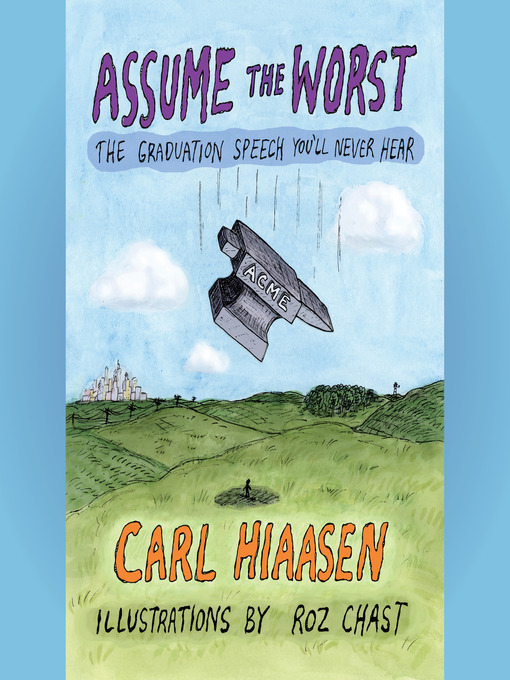
Assume the Worse

 Hiaasen, Carl. Assume the Worse. 2018. 15 mins. ISBN 9780525643135. Available as an audiobook on Overdrive.

Cover of Assume the Worst

If you've ever been to a graduation, you have heard an inspirational speech made from a famous (or not so famous) guest speaker designed to motivate and point out all of the ways in which graduates will impact the world. For the most part, however, these are platitudes that are meaningless. Famous author and reporter Carl Hiaasen set out to create the perfect graduation speech you will never hear. In Assume the Worse, Hiaasen discusses all of the lies and misrepresentations that take place in a graduation speech, and instead focus on telling it like it is, with the hope of warning you about life, not painting a rosy picture that will not live up to expectations.

Filled with wisdom and a clever understanding of the world, all graduates or soon-to-be graduates should listen to this speech and see what the world is really like!