Wednesday, May 14, 2025
Tegan and Sara: Junior High
Wednesday, December 20, 2023
An Appetite for Miracles
Monday, November 6, 2023
Malcom Kid and the Perfect Song
Paramore, Austin; Hassan Otsmane-Elhaou (letterer), and Sarah Bollinger (illustrator). Malcom Kid and the Perfect Song. 2023. 208p. ISBN 9781637152232. Available as a graphic novel on the library shelves.
January was Malcolm's best friend before she moved away. Now that she's back, she's dating the friend that destroyed his keyboard, and she feels partly responsible for that because he was chasing her. So she reconnects with Malcolm, and she offers to replace his keyboard. She's located a pawnshop a few blocks away, so Malcolm and her visit the place. The man offers to sell him a wonderful LK-2000, but at a price that does not include money. January immediately accepts, though Malcolm has misgivings.
That night, Malcolm falls into a dream that feels very real. An older musician sits at a piano, looking for the perfect song. Malcolm awakes to find this was not a dream. The keyboard is actually haunted. Malcolm unloads his keyboard to January, who has the same dream the following night. Unlike Malcolm, however, she talks with the musician, and learns that his name is Midnight, and he was a famous jazz artist in their town. He is stuck here, until he completes the perfect song. January promises that Malcolm will return, and will help him complete his song. The old man is thrilled.
Angry, Malcolm reluctantly agree to help Midnight. As he and January begin to look for clues as to where the perfect song would be, they learn details about themselves and about Malcolm's family that shines a light on secrets that were long buried, and reveals the power that music has on his life.
Wednesday, February 8, 2023
Swing
Wednesday, November 2, 2022
Give Me Some Truth
Gansworth, Eric. Give Me Some Truth. 2018. 432p. ISBN 9781338143546. Available as an audiobook from Overdrive.
Maggi, 15, and her family are Native-Americans who left the reservation near Niagara Falls years ago. Maggi has worked with her mother, her older sister Marie and her twin brother Marvin, to create traditional artwork they sell at the Niagara Falls park to tourists. Marie has met a secretive man, and she wishes to move back to the Reservation, so at the beginning of the story Maggi finds herself once again living in a shack without much creature comforts.
Carson, 17, is a great musician, and he yearns to get off the Reservation. His ticket to New York City starts with winning the upcoming Battle of the Bands. Problem is, he doesn't have a band. So he needs to convince his friend Lewis to join the band. Carson is focused on his own problems, but his abusive father keeps distracting him with his brother's foibles. Derek, Carson's brother, held up a local restaurant, General Custer, and was shot in the behind. Everyone on the Reservation knows everyone else's business, and they now calls him the Hamburglar.
When Maggi moves back to the Reservation, Carson remembers when she was a younger kid, but now finds her attractive. Maggi, for her part, is infatuated with an older man, who works for the school district maintenance team. And that man is the uncle of the boy who has been harassing Lewis, with whom Maggi also works.
As the three of them navigate life, form a band, and learn how to play together, they will learn some hard truths, make some mistakes, and figure out what life really has to offer.
Friday, September 10, 2021
Crescendo
Cheney, Allen and Julie Cantrell. Crescendo: The Story of aMusical Genius Who Forever Changed a Southern Town. 2019. 336p. ISBN 9780785217404.
On the day that Fred Allen died, his sister, who was pregnant, went into labor and delivered a healthy baby boy that she named Fred in honor of her deceased brother. The midwife who helped deliver baby Fred was also known as an oracle, and she predicts that the baby will be very smart, but also very different. Born in striking poverty in rural Georgia during the Great Depression, Fred soon reveals that he is a gifted musician when at three years of age he can play full pieces on the piano without missing a single note.
His parents work in the cotton mills, and their abject poverty and crushing existence lead to Fred being neglected and sexually abused by an uncle. He finds salvation in music, however, and rediscovers his love for singing and playing. Motivated and encouraged by dedicated educators and mentors, Fred escapes his family and heads to college. There he meets Winnie, the love of his life, and after graduation they marry. Fred continues to play music and to seek out a career in the field. Having made many contacts along the way, he moves to New York City with his wife and young daughter and enrolls at the Juilliard School, Union Theological Seminary, which possesses the best organ anywhere in the world, and Columbia University. Juggling all three schools, playing in a church in New Jersey, and his wife and daughter, Fred earns a position at RCA records, and wins Grammies for his producer talents.
None of these accomplishments are fulfilling, however, and Fred still dreams of Broadway. A crushing depression brought on by the developing awareness of his abuse as a child forces him to re-evaluate his priorities, and he moves his family away from New York back to Thomasville, Georgia, where he becomes the leader of a youth choir, and soon joins the faculty at the local high school. With his wife and daughter, he creates an amazing musical program that forty years later continues to be successful.
Fred's life as a musician and educator forever changed so many lives. His positive outlook and his dedication transformed sulky and taciturn teenagers into some of the best singers of his time. Fred's life is proof positive that the impacts educators have on their students can never truly be measured.
Tuesday, January 19, 2021
The Book of the Bagpipe
Cheape, Hugh. The Book of the Bagpipe. 2000. 77p. ISBN 0-8092-9680-2. Available at 788.4 CHE on the library shelves.
For many, bagpipes are synonymous with reverent music and Scotland. Though the origins of the bagpipe is unknown, historical records and illustrations suggest that ancient Egyptians possessed winded pipe instruments similar to bagpipes. Other examples from ancient Greece and Rome indicate that they were played at least since antiquity.
In Scotland, the bagpipe most likely spread from continental Europe with a musical renaissance that followed the clash of civilizations between the Crusaders and Islam in the 11th and 12th century. By the 13th century, there is clear evidence that the bagpipe was already used by minstrels and in royal courts. By the 15th century, various styles of bagpipes had evolved, and the piper had acquired an important social role as the spreader of information.
The rise of the industrial revolution and changes in social mores spelled the end of the local piper, but the rise of an industrialized military force paradoxically increased the need for bagpipe while standardizing both the instrument and the music. Remaining a Scottish emblem, the bagpipe continues to fascinate and delight music lovers everywhere.
Monday, March 2, 2020
Operatic

In a few short months, Charlie is leaving middle school and heading to high school. Her favorite class in 8th grade is Mr. K's music class. Her best friends, Addie, Rachel, and Mayin are also in the class with her. Mr. K. enthusiastically presents the world of music, and asks each student to find the song that inspires them and that represents their life. For the rest of the year, Charlie and her classmates will be exploring different music genres, trying to find the song that defines them.
Charlie is not sure what music most represents her, and she finds it difficult to concentrate when Emile, a quiet student, is in the same class as her. She breaks out sweating whenever he talks to her. Emile has not been the same since Luka disappeared from their music class. Luka moved in the area a few months ago and immediately struck the school as eccentric. When Luka declared his love for Emile in front of the music class, the laughter that resulted drove him out and he hasn't come back since.
As she searches for her song, Charlie comes across Maria Callas, an operatic singer from the 1940s to the 1960s. Maria Callas was not appreciated by her schoolmates, but she ignored her detractors and achieved her goal of being an opera singer. She transformed herself into a glamorous woman and lit up many theatres throughout her career. Even at the height of her skills, however, she had detractors that found her voice lacking. Charlie relates to Maria's story, and is moved by her music. She has now found her song.
With only a few weeks left and a performance in front of the school, can Charlie manage to reunite Emile and Luka, help her friend Addie with her anxiety, and learn some truth about herself in the process?
Tuesday, February 11, 2020
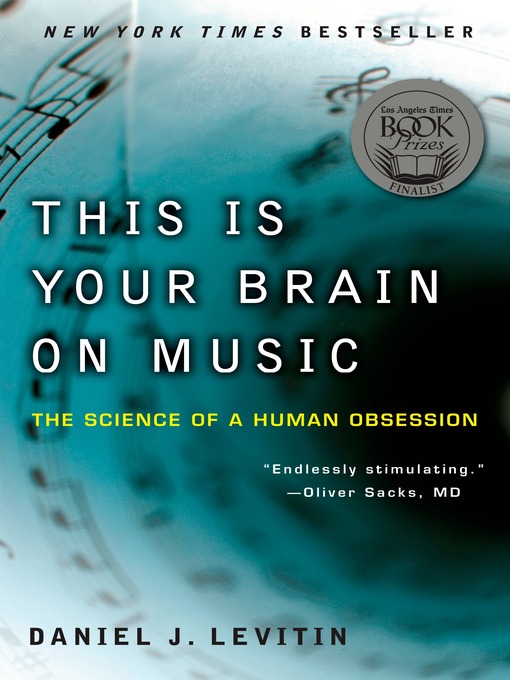
This is Your Brain on MusicThis is Your Brain on Music: The Science of a Human Obsession
Music is like any skill. Though there are some prodigies who master it very quickly, for most it is countless hours of practice that leads to mastery. Music itself plays upon the same neuron pathways that language uses, and can be used to communicate information. We may not consider ourselves musical, but our ears are perfectly evolved to detect and appreciate harmonics that even a super computer has trouble processing. How music affects our brain helps us understand not only how our brain works, but how our species evolved rhythms and sounds to attract mates and how this then led to actual language.
Fans of music will appreciate the research behind how we hear and appreciate music, as well as the history of how it has come to be an important part of humanity.
Tuesday, November 26, 2019
Pharrell