Showing posts with label Reading. Show all posts

Wednesday, December 6, 2023

Hamlet is Not Okay

Spratt, R. A. Hamlet is Not Okay. 2023. 224p. ISBN 9780143779278.


To say that Selby is not a fan of reading would be an understatement. In fact, Selby positively hates reading. It is difficult, and she often doesn't comprehend the text. Which is ironic, considering her parents own a bookstore and Selby works there part time. A couple years ago, Selby realized that she didn't have to read the assigned texts in class to still pass. Until she got to Shakespeare. Seeing her failing grade in English, her parents ground Selby. No more television, no more hanging out with friends. Now it's all about staying home, working, and reading Hamlet so Selby can pass her English class.

But when Selby begins reading Hamlet, with the help of Dan, another teen who works in the bookstore, they find themselves transported into the play itself, where everything comes to life. Armed with modern sensibilities and the overconfidence teens possess, Selby and Dan set off to avoid, or at least prevent, many of the tragedies that occur in the play. Her interventions reveal that Hamlet's fateful decisions were guided not by madness, but by the fact that he was slowly being poisoned by his uncle.

Transported back to their time, Hamlet makes quite an impression on Selby's parents, and his promise of marrying her is borne more from grief than from true love. Selby decides she must return Hamlet to his own story, before he takes over her own. And in the process, Selby develops a deep appreciation and understanding of the story and of the characters, allowing her to finally pass her English class and prove to her parents that she "read" Shakespeare.

A very cool take on a classic of English literature, Selby's adventures with Dan and Hamlet provides a hilarious take on what could be if one had the ability to rewrite a story. Fans of Shakespeare will appreciate this wonderfully crafted take on a book that can be hard to understand!

Friday, January 7, 2022

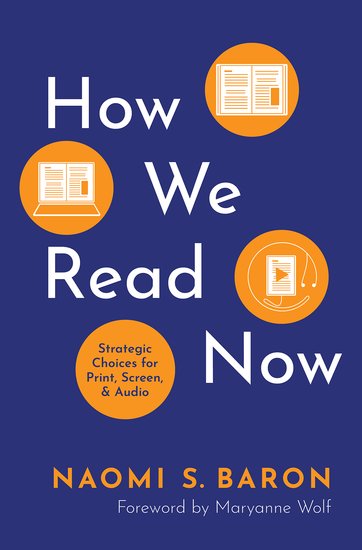
How We Read Now: Strategic Choices for Print, Screen, and Audio

 Baron, Naomi. How We Read Now: Strategic Choices for Print, Screen, and Audio. 2021. 285p. ISBN 978-0190084097.

Book Cover


The headlong rush in education to electronic textbooks and other digital books fundamentally changes how people read for learning, argues Naomi Baron in How We Read Now: Strategic Choices for Print, Screen, and Audio. School administrators and teachers have adopted electronic textbooks as cost-cutting measures without thinking about how reading on a device differs from reading in print. Libraries have adopted digital books for ease of use, their accessibility features, as well as the fact that they are available even when the facility is closed. Still, patrons have not been educated on how to effectively read in a digital environment. Readers enjoy the portability of hundreds of digital titles but have neither necessarily thought about what is lacking in their reading experience when one cannot hold a book, nor how a digital device may affect the way they read. An expert in the field of reading, Baron summarizes two decades of research from around the world on the impact of digital books on reading. She presents avenues educators and school librarians must explore to ensure that students are properly equipped with the tools they will need to successfully read to learn in multiple formats and achieve the multiple literacies our society increasingly demands.

For thousands of years prior to reading becoming the primary means of transmitting information, orality was the preferred method, and in many cultures it was the only method (Baron, 2021, p. 186). The rise of reading as a means of learning is a recent phenomenon (Baron, 2021, p. 157; Fisher, 2004, p 214), and its nearly ubiquitous presence as a social norm is even newer. An individual must be taught the skills necessary to decode information. Students have been taught from a young age that reading as a model consists of using eyes to go through lines of text in a more or less linear fashion and from the front cover to the back cover. The reading people perform today does not remotely resemble that model of reading. Digital reading on social media and websites is changing how individuals read and why they read, Baron (2021) argues (p. 78). Individuals now tend to read small chunks of texts on a device, listen to podcasts or audiobooks while doing other activities, or watch videos to entertain themselves or learn new skills. All of these are literary activities that provide the “reader” with information. The definition of reading, Baron asserts, needs to change to reflect today’s reality that literacy has transformed in the last hundred years, from the ability to read and write basic texts to the need to comprehend increasingly complex sets of information (Baron, 2021, p. 13). 

School librarians are both purchasers and consumers of digital books. They understand how digital media is consumed. They know how to operate digital books. Due to their role at the center of the school’s scholarly activities, school librarians are therefore well-positioned to facilitate this change. They must educate both teachers and students on this changing literacy and present ways for readers to adapt the skills they already possess to a new form of reading.

The first step is to recognize that there are differences between digital literacy and print literacy. Print books are self-contained within the physical object. The object presents itself the way the author meant it to appear, aside from possible editorial and formatting decisions in production. It also provides visual landmarks indicating where the reader is in relation to the size of the book, specific chapters, or even individual pages, for example, remembering that critical graph on the page next to the photo of the Grand Canyon or noticing that a book is twice the size of another book. Print books provide great cover art that can be admired. They can also be shared with friends or given away. 

On the other hand, print books can be cumbersome and expensive, require storage when not in use, and can easily be damaged or lost. Digital books are well suited for certain purposes such as quickly locating information, shallow reading, scrolling, and improved accessibility features that benefit students with visual impairments as well as those with dyslexia. Digital books are generally less expensive than print books and are much more convenient to access and dispose of after reading. Digital books are often more engaging than print books due to interactive features and embedded multimedia. Digital books provide hyperlinks to other elements, such as chapters, footnotes, other webpages, etc. The reader can modify page layouts and font size, changing the way the author intended the book to look. Digital books embed multimedia files such as audio and video. They are easy to access, are portable, cannot be damaged or lost, and present no storage difficulties. Digital books are not easily shared, they do not provide the reader a visual landscape, and they are often read quickly and superficially, with limited engagement with the text (Baron, 2021, p. 68).

Audiobooks provide exposure to literary texts, increase the quantity of literature students consume, and help generate positive attitudes toward reading (Wolfson, 2008). They can be sped up, helping students with ADHD better focus on what they hear. However, digital books are not conducive to deep and reflective reading requiring frequent pauses and engagement with the text (Baron, 2021, p. 121). Audiobooks and videos possess similar features to digital books with additional drawbacks. These include the inability to quickly rewind or locate a relevant passage or the lack of visible landmarks to quickly search for specific locations within the content (Baron, 2021., p. 166).

The second step is to consider that not all forms of reading are equal. Reading fiction is different from reading informational texts, which differs from reading posts on social media or signs on the side of the highway. Baron notes that data analyzed from the 2009 international PISA test showed that students who reported reading fiction regularly had higher reading scores than those who did not read on a regular basis. Students who reported reading informational texts regularly did not have higher scores than students who did not read on a regular basis (Baron, 2021, p. 26). This effect of reading long forms of fiction also showed improved overall reading comprehension. Yet, most of the online reading being done in schools and on standardized tests are of short texts, affecting both comprehension and reading stamina (Baron, 2021, p. 117).. Stamina is necessary to read long texts such as books and scholarly articles. Still, the digital environment provides information into bite-size pieces that can easily be consumed in a few seconds or minutes. These limited reading opportunities, along with the distractibility factor of devices and the rise of audio and video media, have shortened the attention span of the typical reader (Attention! Attention!, 2017, p. 36). Devices allow for quick reading but do not facilitate deep reading. Most readers are unaware of these differences between print and digital. They blaze through digital books like they were short websites, finding themselves surprised when they don’t remember much of what they read (Singer & Alexander, 2017). 

The news is not all bad, Baron notes. Digital books can fulfill many roles in the educational system. School librarians and teachers must prepare their students by explicitly demonstrating appropriate techniques to foster a deeper level of engagement with the text and to reflect on what is being read. For starters, students should not be multitasking. Devices make it easy to multitask, and even reading print is often interrupted by the desire to check notifications, answer messages, or peruse social media (Baron, 2021, p. 77). When listening to audiobooks, readers must focus on what they hear, since the mind has a greater tendency to drift away from sound than from print. Stopping the flow of reading impedes their cognitive efforts and hinders their comprehension. Regardless of the format being read, students need to take notes about what they are actively reading (Baron, 2021, p. 36). They must be comfortable with flipping the pages backwards or rewinding audio or video. They should write up a summary of what was read along with a series of keywords that relate to what they just learned (Baron, 2021, p. 138). Students need the modeling of good print and digital reading and the opportunity to explore these different media types (Baron, 2021, p. 228), something school librarians can provide. For their part, teachers should generate questions ahead of time to guide students’ attention to specific themes or sections and should consider supporting documentation to build or enhance prior knowledge. This will help students become biliterate and able to recognize the different purposes of each medium.It also helps them to develop techniques that make each media better for a specific purpose, and build an understanding of the limitations that each medium possesses.

What can school librarians do to help students and teachers through this transition to a different definition of reading? First, they need to continue to promote reading in all of its forms. Especially in the younger grades, school librarians need to work with families to help them promote reading at home as well. Evidence suggests that reading fiction improves both reading comprehension and overall reading abilities (Baron, 2021, p. 26). Fiction is particularly suited for print reading. Second, school librarians need to offer books for pleasure reading and books for research in multiple formats. They need to purchase different reading formats and offer students the opportunity to read print, digital or audio versions of their favorite books. Third, school librarians must work closely with therapists and teachers, especially English teachers, to teach effective techniques for deep reading with digital and listening to audio formats, including writing annotations, summarizing what is being read, and creating lists of keywords. Learning how to navigate digital and audiobooks, including rewinding or scrolling back to read or listen again, is also essential. Finally, teachers themselves are not necessarily familiar with the features that their textbooks possess. School librarians need to help teachers who use digital books exploit this format’s strengths, from the easy searching capabilities to the differentiated texts and the ability to make annotations right in the textbook. School librarians must work with teachers to educate students about best practices when using digital books.

Ultimately, Baron argues, readers must ask themselves the following question: What is the purpose of their reading in that particular time and place? Training students to answer this question and to know their purpose when reading is the most effective way for school librarians to help students determine which book medium is best situated to fulfill their reading needs at any given time. Still, some questions remain unanswered at this time. What will the future of reading hold? Will digital reading transform how we currently define reading? Will small bursts of information texts become the privileged form of reading? 

Despite these currently unanswerable questions, Baron’s closing advice does not ring less true: “Read more. Focus when you do. Medium matters'' (2021, p. 230). School librarians could not agree more!


References


Attention! Attention! (2017). New Scientist, 233(3112), 36.


Fisher, S. R. (2004). A history of reading. ​​Reaktion Books.


Singer, L. M., & Alexander, P. A. (2017). Reading across mediums: Effects of reading digital and print texts on comprehension and calibration. Journal of Experimental Education, 85(1), 155–172. https://doi.org/10.1080/00220973.2016.1143794 


Wolfson, G. (2008). Using audiobooks to meet the needs of adolescent readers. American Secondary Education, 36(2), 105–114.

Wednesday, January 6, 2021

Dr. Seuss

 Levine, Stuart P. Dr. Seuss. Part of the Importance Of series. 2001. 112p. ISBN 978-1-56006-748-9. Available at  813 LEV on the library shelves.


Growing up, Theodor Giesel loved to draw funny pictures and play with words. His childhood home was filled with books, and his mother strongly encouraged him to read. His father, who first worked in the family brewery, transitioned to running the public park system in Springfield, Massachusetts, and was in charge of the zoo. Young Theodore thus spent a lot of time reading books and watching zoo animals.

He completed a degree at Dartmouth, then went to Oxford to do a doctorate but left to pursue his artistic inclinations, first as an illustrator for magazines, then for advertisement, before he released a children's book in 1937 called And to Think That I Saw It on Mulberry Street. Completely different than most young reader primers, Dr. Seuss' first book featured rhymes and strange illustrations that fostered a love of reading. This new approach would change the world of beginner books.

Giesel worked in propaganda for the U.S. Army during the Second World War, and returned to writing children's books, creating such beloved gems as How the Grinch Stole Christmas and The Cat in the Hat. An obsolete child, as he liked to call himself, Dr. Seuss never truly grew up, and retained an attachment to what children enjoyed reading. After more than 60 books, movies, and theme parks, Dr. Seuss's creations remain beloved by millions, proving that children can become excellent readers.

Friday, September 7, 2018

Readers Writing: Lessons for Responding to Narrative and Informational Text

Hale, Elizabeth. Readers Writing: Lessons for Responding to Narrative and Informational Text. 2014. 196p. ISBN 978-1-57110-843-2. Available at PROF 372.62 HAL on the library shelves.


Back in the 1970s and 1980s, teachers asked their readers to interact with their books by writing a summary. Oftentimes, rewards programs were attached to completing as many summaries as possible. Not much information was retained, however, and this type of activity did not help develop reading skills. Over the last two decades, thorough comprehension strategies have been developed, but it continues to prove difficult to demonstrate to struggling readers how good readers create their own understanding when they read books.


Hale has created almost a hundred lessons that present specific comprehension strategies that each and every student can master. She outlines an approach to implement these strategies with the whole class, and how to monitor both for success and for further development. She discusses her conference process and how she talks with her students about their strengths and weaknesses in reading, and their next area of focus. This book centers on addressing the need to explicitly name and teach reading comprehension skills and then help students incorporate them in their writings to demonstrate mastery. Each strategy she presents includes the same format: the strategy is named, so that students can explicitly refer to it; an explanation of why this strategy is important, a model of how to discuss this strategy, the opportunity to try it on one’s own or with a partner, and the ability to share it. Readers use a notebook to keep track of strategies and to document their independent writing. Each strategy focuses on an aspect of reading, such as questioning, connecting, analyzing, synthesizing, evaluating, visualizing, or monitoring.


Becoming a lifelong reader is a goal everyone can reach, and Hale’s techniques and strategies are specific and easily implementable as part of a curricular approach to reading. Every reading teacher or professional librarian needs to read this book!

Friday, December 16, 2016

Lit Up: One Reporter, Three Schools, Twenty-Four Books that Can Change Lives

Denby, David. Lit Up: One Reporter, Three Schools, Twenty-Four Books that Can Change Lives. 2016. 613 minutes. 288p. ISBN 9780805095852. Available as an audiobook on Overdrive.


One of the most important challenges school librarians face everywhere is the decline in reading. Students who read up a storm in elementary school still bring that enthusiasm to middle school but by 8th or 9th grade the number of active readers decline precipitously. Denby decided to sit on a 10th grade English class at a New York City magnet school for a year to examine this phenomenon and to see how English teachers everywhere try to counteract it.

His qualitative findings suggest that students can overcome their aversion of sustained reading, which they too often associate with school work or requirements and regain the reading for pleasure that many of them had when they were younger. Teachers who are able to inspire their students re-ignite a love of reading that has gone missing from the current testing all the time environment. Denby identifies several laddering strategies the teachers employ to help students access harder literature, and suggests that even if students only read popular novels, at least they are reading.


A great food for thought, this book would make an excellent faculty read or book club read. It challenges preconceived notions about students and their reading habits and it suggests some possible steps to take and counteract the decline of reading.

Tuesday, September 20, 2016

Tips & Tricks for Summarizing Text

Athans, Sandra K. and Robin W. Parente. Tips & Tricks for Summarizing Text. 2015. 64p. ISBN 978-1-4777-7583-7. Available at 372.6 ATH on the library shelves.


The way we teach reading has evolved to meet the challenges offered by the Common Core State Standards. Now, students are expected to react to what they read by creating an argument and supporting it with evidence from the text. In this series, the authors demonstrate several tips and tricks to help the reader confidently summarize a text he or she has read.

The authors present four texts to showcase their advice. In the first text, which deals with literature, , the reader examines an excerpt from Myths of the World: The Ancient Chinese and with the help of a T chart where the central themes, recurring ideas, and pivotal ideas are noted and help write a summary of what was read. The reader is then asked to read another excerpt from the same book and perform a similar action as the previous chapter.

The third and fourth texts are informational in nature, and present passages from Perspective On: The Titanic Tragedy and from The Muckrakers: American Journalism During the Age of Reform. The expert reader performs a similar technique as chapter 2 to complete a summary, and the reader is asked to do the same with the fourth and last passage.

This book thus provides the reader the opportunity to refresh their reading techniques as well as acquire new ones and examine how reflecting on their own reading skills can help them become better readers.

Other books in this series include:

Friday, May 20, 2016

Whirligig

Fleischman, Paul. Whirligig. 1998. 133p. ISBN 0-8050-5582-7. Available at FIC FLE on the library shelves.


Brent Bishop has always tried to impress the people at his school, and he’s had his eye on beautiful Brianna. But when she rejects him at a party in front of everyone, Brent loses face. Drunk and unhappy, he gets back in his car and drives away. Hoping to die, he takes his hands off the wheel, and lets the car drift….


The ensuing arrest, trial, and sentencing for the manslaughter of a girl he killed while driving drunk leaves him numb. He can’t believe he murdered someone. Then during a restitution meeting, the victim’s mother gives him one task: To travel to the four corners of the United States, build and place a whirligig that looks like her daughter there. Brent agrees to do it, and begins his trip of redemption.


Told from five different perspective, Brent’s trip through the United States is interspersed with the voice of a person whose life is changed by the whirligig Brent has placed in their little corner of the world. A tale of redemption in the face of an unspeakable tragedy, readers will appreciate the growth Brent undergoes during his travels, and will be reflecting on how our actions affect people we do not know long after we’ve done them.


Monday, May 9, 2016

Tips & Tricks for Evaluating Multimedia Content

Athans, Sandra K. and Robin W. Parente. Tips & Tricks for Evaluating Multimedia Content. 2015. 64p. ISBN 978-1-4777-7563-9. Available at 372.47 ATH on the library shelves.


The Common Core State Standards not only changed how reading and literacy is taught, but also added digital literacy skills students should possess as they ready themselves for career and college. With computers now ubiquitous, knowing and mastering the skills necessary to evaluate multimedia content is therefore essential.


This book reviews digital literacy skills and presents the same information twice. First, the written text is discussed by the expert reader. Then, a multimedia clip of the same text is explored and reviewed by the expert reader. The reader is thus provided with several opportunities to compare and contrast two pieces of reading in different format: written, and multimedia. Images, videos, and maps are explored. The material is well presented and the skills taught are easily implementable.


Monday, April 18, 2016

Tips & Tricks for Determining Point of View and Purpose

Athans, Sandra K. and Robin W. Parente. Tips & Tricks for Determining Point of View and Purpose. 2015. 64p. ISBN 978-1-4777-7555-4. Available at 372.47 ATH on the library shelves.


The arrival of the Common Core State Standards has changed the way we teach reading, placing a greater emphasis on reacting to a reading by finding textual evidence to support one’s argument. In this series, the authors demonstrate tips and tricks the reader can use to analyze the text. This particular book is focused on detecting the author’s point of view and the purpose in writing.


Four texts are examined. Two literary texts examined are the famous painting the fence incident from the Adventures of Tom Sawyer, and an introduction to H.G. Well’s Time Machine. The purpose and the point of view are clearly identified through techniques described by the expert reader. The second set of two informational texts are a section of Theodore Roosevelt’s biography and an editorial penned by Arthur Brisbane on the value of working hard for one’s own sake. The purpose and point of view of these texts is also examined by the expert reader.


Thursday, April 7, 2016

Tips & Tricks for Analyzing Ideas, Events, and Individuals

Athans, Sandra K. and Robin W. Parente. Tips & Tricks for Analyzing Ideas, Events, and Individuals. 2015. 64p. ISBN 978-1-4777-7531-8. Available at 428.4 ATH on the library shelves.


The Common Core Standards have changed the way we read in schools, moving away from literature and concentrating more on informational texts. And these texts require different skill sets to fully understand and appreciate them. Students are now asked to be able to recognize the central ideas that underpin a document, and consider the statements that support and defend these ideas.


This book provides the reader with specific techniques and advice on how to successfully understand and analyze the ideas embedded in both informational and literature texts. Two fiction experts are first taken apart and examined, before two informational pieces, Lincoln’s 1862 address to Congress and Roosevelt’s 1933 inaugural speech, are studied. The authors apply the techniques they described, from looking at the headings and the pictures included with a text to reflecting on their expert understanding of what was just read. The suggestions provided by the authors better prepare the reader for school and career readiness.

This is a great way for readers to refresh their reading techniques as well as acquire new ones and examine how reflecting on their own reading skills can help them become better readers.


Thursday, March 24, 2016

Tips & Tricks for Evaluating an Argument and its Claims

Athans, Sandra K. and Robin W. Parente. Tips & Tricks for Evaluating an Argument and its Claims. 2015. 64p. ISBN 978-1-4777-775592. Available at 808.03 ATH on the library shelves.


How do you evaluate the validity of an argument? The Common Core has transformed reading, focusing more on supporting evidence with textual information. Most informational text make an argument, either in favor of, against, or with a neutral position. Those arguments present claims to support their central idea. But as a reader it is up to you to determine whether an argument made is supported by facts or whether it is in fact inaccurate.


This book provides the reader with specific techniques and advice on how to successfully evaluate and argument and its claim by using evidence from informational texts. It presents two pieces for and against animal rights and immigration, two topics that evoke strong reactions. The expert then guides the reader through a rigorous analysis of the text by looking at the evidence submitted to support the argument made by each side, and then condenses these claims and their supporting evidence into a T-chart.


Wednesday, March 16, 2016

Tips & Tricks for Analyzing Text and Citing Evidence

Athans, Sandra K. and Robin W. Parente. Tips & Tricks for Analyzing Text and Citing Evidence. 2015. 64p. ISBN 978-1-4777-77539-4. Available at 372.47 ATH on the library shelves.


How do you read a text? The Common Core has transformed reading, focusing more on supporting evidence with textual information than relating the text to one’s own experiences and emotions. But close reading a text require a different set of strategies than required for pleasure reading.


This book provides the reader with specific techniques and advice on how to successfully analyze text and cite evidence from both informational and literature texts. Two chapters of the Odyssey are examined, along with two informational texts on the possible existence of Atlantis. The authors demonstrate these techniques as they read through the texts, writing down ideas, concerns, and questions they still have. They provide examples of summaries that draw on specific evidence from the text as well as questions that allow the reader to check their understanding. These techniques better prepare the reader for school and career readiness.